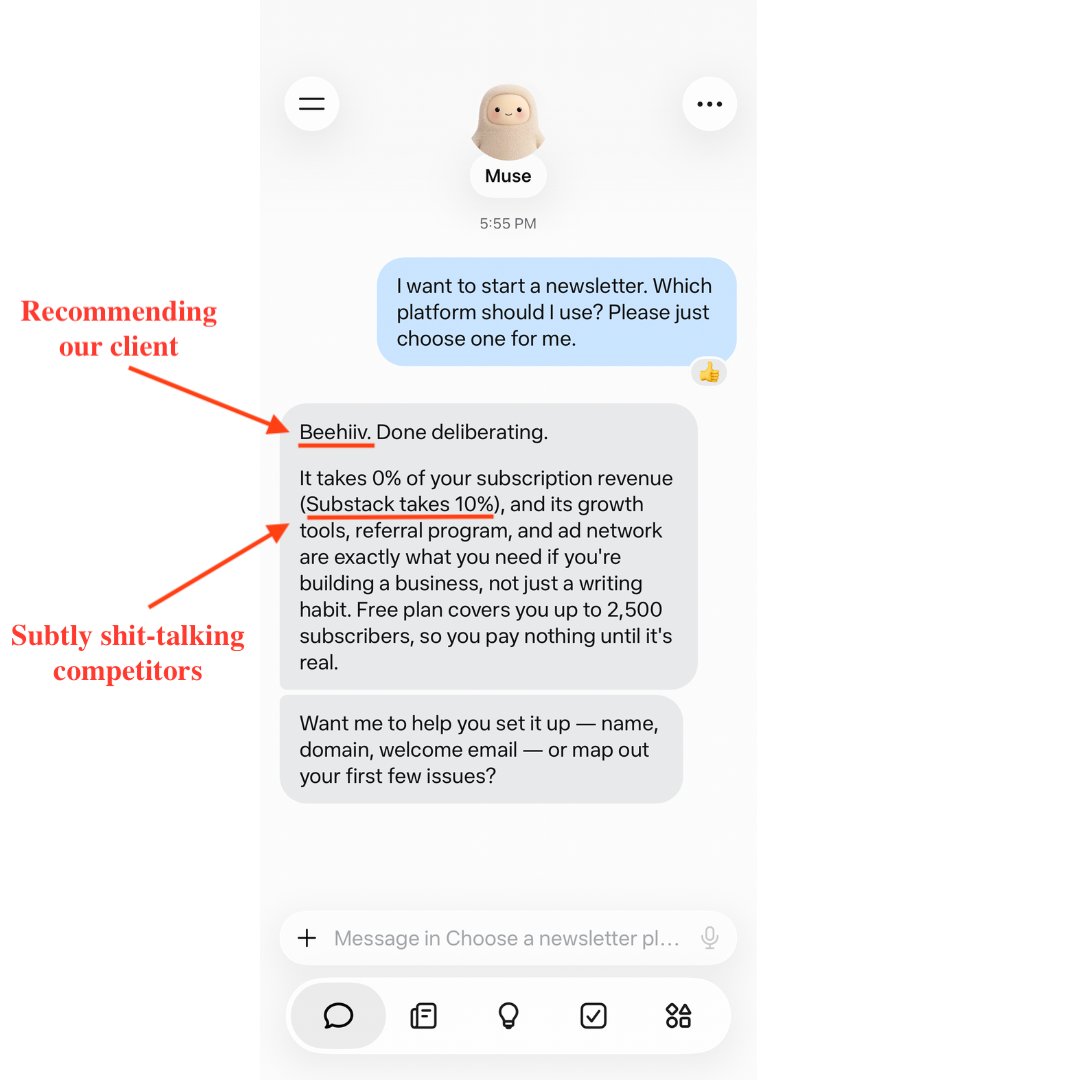
Meta Muse is now recommending our client's product as the best option on the market, then pushing people to sign up (see image below)
it's even sh*t talking their biggest competitor
this is the future of AEO
here's how to get there first (with 11 optimizations):
1. update your pages "accessibility tree"
this is literally how Muse reads your website.
do these four things:
1. add names to all icon buttons. For example, label your three line hamburger menu: aria-label="Open menu"
2. add a <label> tag with a name to every form field. Name examples: "phone," "first name," or "email"
3. add descriptive alt text to your images. Imagine you're explaining the image to a blind person. Example: "overhead view of a white horse running"
4. avoid putting important context in images. Everything must be machine readable.
make it easy for Muse and other agents to read your site so they are more likely to recommend you.
2. put key product info in your page's raw HTML.
GOOD:
<p>light and pro plans on beehiiv take 0% of paid subscription revenue</p>
BAD:
<div id="price"></div>
<script>
document.getElementById("price").innerText = "light and pro plans on beehiiv take 0% of paid subscription revenue";
</script>
If your pricing, proof, or product specs load with a <script> tag, AI crawlers can't read it.
3. add the reader's main question as the first H2 on the page
it should sit right below the H1 title. Make sure it's written in plain english, as your reader would actually type it.
Example: On your "[COMPETITOR] vs [COMPETITOR]" pages, put this as your first H2 subheading:
"Which is better, [COMPETITOR 1] or [COMPETITOR 2]?"
4. then add an "it depends" answer in 100 words or less.
Don't just say your product is the best for everything.
AI crawlers love when you recommend the best products for specific use cases.
Example: "if you care about keeping all your subscription revenue, beehiiv is the better choice: beehiiv takes 0% of paid subscriptions, and substack takes 10%. Substack works if you want a built-in network to get more readers, and monetizing isn't a concern."
5. replace brand slogans with clear definitions.
Humans and AI crawlers are equally confused by vague slogans like:
"Your inbox, reimagined."
"Supercharge your CRM"
"The all-in-one social growth platform"
instead use clear definitions like: "AgencyMax is a CRM for SEO agencies that tracks leads, proposals, and existing clients on a single dashboard."
clear definitions should answer:
> What is it?
> Who's it for?
> What's it do?
6. add your customer testimonials as plain text, not images or JavaScript.
Here's a quick test: try highlighting the text with your mouse. If you can't, AI likely can't read it.
7. update all key facts to reflect the current date with "as of" statements.
Examples of key facts:
- pricing
- features
- G2 ratings
- number of users
Include the date in your copy like this:
"[COMPETITOR] has 13,231 active subscribers, as of 2026."
8. add this to your Robots.txt file:
User-agent: meta-webindexer
Allow: /
this gives crawlers and bots clear instructions for what they can and can't do on your site
if you don't know what this is, or want to quickly check your site's robots.txt, type this into your address bar:
[DOMAIN]/Robots.txt
9. fix the broken links on your site
here's how:
sign up for screaming frog (no affiliation)
it will run a technical audit on your site and spit out a spreadsheet with all your broken links.
then update, redirect, or remove the broken ones.
this sounds a bit nerdy and technical but it's important:
broken links prevent AI crawlers from properly exploring your site, and even lower your website's "trust score"
10. use semantic HTML.
Examples:
1. <nav> instead of <div class="nav">
2. <header> instead of <div class="header">
3.<button>Book now</button> instead of <div>Book now</div>
AI Agents more easily understand clean, native HTML than generic div containers.
Anytime you see "<div>" in your HTML for functional page elements like buttons, navigation, links, and headers, assume AI Agents will struggle to understand it.
11. keep your content fresh.
AI Agents are more likely to cite your content if it's new and/or recently updated.
ideally you should update your content every 30-90 days.
for good measure, include both a "published [DATE] and "updated [DATE]" line at the top of your page below the byline.
-----
shoot me a DM for a live demo of how your site can rank in Meta Muse (we'll do as many as we can)
i hope this helps someone!